

Fully integrated management systems
Most organisations don’t struggle because their teams lack effort. They struggle because their systems don’t work together.

Data lives in too many places. Processes rely on memory instead of structure. Compliance becomes an endless chase. Reporting is unreliable. And as the organisation grows, the gaps widen.
These problems are universal, from health care, financial services, accident management to retail operations.
Different industries, same underlying issue:
your business is being held together by tools that were never designed to connect.

When your CRM holds customer data, spreadsheets track activity, shared drives store documents, emails carry communication, provider portals supply updates and legacy tools plug the gaps, you end up juggling a maze of systems that don’t talk to each other, creating duplication, slowing decisions and making it almost impossible to get one clear, accurate view of anything.
A growing financial services firm approached us with a long-standing operational problem. Their advisors were working across pensions, investments, mortgages, insurance, wills and estate planning, but each service area was being managed through different tools, portals and spreadsheets. Client information was scattered across emails, shared drives, spreadsheets, PDFs and third-party systems. Nothing connected. Nothing flowed. And every case required manual checking just to move to the next stage.
The result was predictable: slow turnaround times, inconsistent processes, duplicated effort and constant compliance pressure.


The firm operated in a highly regulated environment and needed a smarter way to manage the constant flow of client activity across multiple financial products.

Their existing setup created operational drag, with information fragmented across several platforms and no reliable way to keep work moving efficiently.

We designed a unified, automated system built on the Zoho ecosystem that streamlined every stage of their workflow and centralised all operational activity.

The business now runs on a single, integrated platform that increases accuracy, speeds up delivery and gives leadership complete visibility across the organisation.
The firm had reached a point where their existing operational setup was no longer fit for purpose. Each service line was being handled through separate tools, and the gaps between those systems were creating friction across the entire business. Advisors were constantly switching between applications, re-entering information, tracking details manually and checking multiple locations just to confirm basic case progress. The lack of connection meant they were relying on memory and manual effort to keep work moving, which is risky in any organisation, but especially in one regulated so tightly.

Leadership knew that continuing to operate this way would make it impossible to grow. Every new client and every new service increased the strain on their already stretched processes. Without a centralised system or reliable workflow structure, they were at real risk of building operational debt — the point where a business can no longer scale because its systems can’t keep up.

To resolve this, we partnered with the firm to design a system that united every part of their operation. Using Zoho CRM as the backbone, we created a single source of truth for all client and case information, eliminating the confusion caused by separate data locations. Zoho Creator was used to build detailed, product-specific workflows for each financial service the firm offered. These workflows guide advisors through each stage in the correct order, automatically enforcing compliance checks, validating inputs and triggering the next steps. The advisors moved from a manual, memory-driven process to a structured pipeline that removes ambiguity and reduces risk.
Automated documentation was introduced through Zoho Sign, ensuring every form, declaration and agreement moved through a consistent digital process. Documents are generated automatically, sent for signature, and stored securely in the right location without staff intervention. Zoho Flow then tied the entire ecosystem together, synchronising records, triggering cross-app actions and ensuring each part of the system stayed aligned.


Alongside this, we developed extensive Deluge scripting to automate complex rules, calculations and case logic that would normally require specialist knowledge. These scripts handle tasks instantly and consistently, reducing the risk of human error and freeing advisors to focus on clients rather than administration. We also integrated the system with key financial providers through API connections, eliminating the need to log into multiple platforms and ensuring the most up-to-date information flowed directly into each case.


The impact has been transformative. Instead of operating in isolated systems, the firm now runs entirely from a single, connected platform. Advisors have a clear, predictable workflow for every service they deliver. Compliance is embedded into the process itself rather than being an afterthought. Documentation moves automatically. Case progression is faster and more accurate. Leadership can see what’s happening across the business at any moment. Most importantly, the entire operation is scalable — the firm can now increase its client base without increasing administrative burden.
This integrated system has become the operational foundation of the business, supporting every interaction, every service and every compliance requirement. By replacing fragmented tools with a unified platform, the firm has achieved greater control, higher efficiency and a level of operational clarity that simply wasn’t possible before.
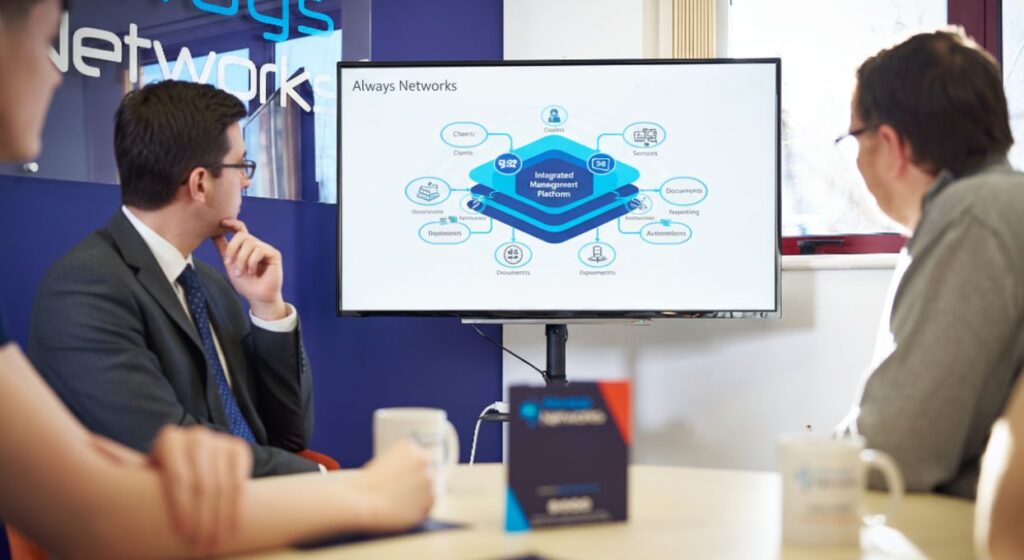
At Always Networks, we design and build fully integrated management systems using the Zoho ecosystem. These aren’t templates or simple CRM setups. They are complete operational platforms that unify your data, documents, communication, workflows, compliance, reporting and automations into one intelligent, centralised system.
The goal is simple: To replace fragmented tools with a single operational engine that reflects exactly how your organisation works.
Your clients, cases, services, approvals, documents, communications and reports all flow through one system, not ten separate ones.

Financial services firms deal with an unusually high volume of client data, documentation, regulatory requirements and multi-stage processes. Over time, most advisory businesses begin to layer new tools on top of old ones, a CRM here, a spreadsheet there, a provider portal for each product type, plus shared drives, email folders and legacy databases. Everything works “well enough” until client volume grows and the cracks widen.
The real problem is that none of these systems communicate with each other. Advisors end up duplicating information, checking multiple locations for updates, chasing documentation manually and piecing together a client story from half a dozen sources. This creates operational risk, slows case progression and makes compliance harder than it needs to be. An integrated management system removes this fragmentation by bringing all data, processes, documents, approvals and reporting into one central platform.
A fully integrated Zoho-based system doesn’t replace a single tool, it replaces the need for a patchwork of disconnected workflows. In a typical financial services environment, this means eliminating manual spreadsheets, reducing reliance on email chains, removing the need to log into multiple product provider portals, and centralising all documents and case notes. It also replaces manual risk assessments, suitability checks, document tracking, signature chasing and status updates that normally consume hours of adviser time each week.
Instead, the system acts as the operational backbone of the entire business. Advisors follow structured workflows inside Zoho Creator, all client and case data is held in Zoho CRM, documentation moves through Zoho Sign, compliance rules are automated with Deluge scripting, and leadership has real-time visibility through Zoho Analytics. Everything runs inside one controlled ecosystem.
In regulated industries, compliance isn’t optional, it’s fundamental. Automation ensures the required steps happen in the correct order, with nothing left to memory or chance. A well-designed Zoho system can automatically check for missing documents, incomplete fact-finds, out-of-date risk profiles or unsigned declarations. It can enforce approval requirements, ensure every suitability step is completed and generate the correct templates at the right time.
The result is a controlled, repeatable process that removes human error and guarantees consistency across every adviser and every service line. Compliance officers can view real-time dashboards showing outstanding items, document statuses, risk levels and upcoming renewals. Audits become easier because every action is timestamped, tracked and stored in the relevant client record. This is one of the biggest reasons financial services firms move towards integrated systems, compliance becomes built-in rather than bolted on.
Financial advisers often rely on external systems, provider platforms, investment portals, mortgage sourcing tools, fund information feeds and more. Without API connections, staff spend countless hours rekeying data, downloading PDFs, uploading documents and manually updating case notes. This creates delays and increases the risk of introducing errors.
With API integrations, Zoho can automatically pull provider data directly into the case record, update statuses, import documents, validate client details and push updates back out where needed. Admin teams no longer have to chase information or log into multiple systems — the platform acts as a single point of truth. This saves significant time, improves accuracy, and ensures up-to-date provider information is available instantly during client conversations.
Most advisory firms reach a growth ceiling because their processes don’t scale efficiently. Each new client means more documents to track, more checks to run, more emails to chase and more tasks to update manually. Without automation, adding more clients eventually requires adding more staff, which increases costs and slows growth.
An integrated management system removes that friction. Once workflows, compliance checks, documentation flows, data validation and reporting are automated, the business can handle far greater volume without increasing administrative burden. Advisors spend more time advising and significantly less time doing admin. Leadership gains instant visibility of bottlenecks, workloads and risks, making it easier to plan growth, allocate resources and improve client service. The firm becomes operationally scalable, able to grow without breaking its own infrastructure.